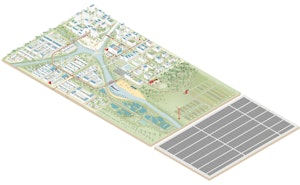
Balanswijk
How to integrate circular energy systems into new urban neighborhood designs? Grid congestion has rapidly developed into a major obstruction for urban developments. What if a new neighborhood can provide balance?
A speculative alternative
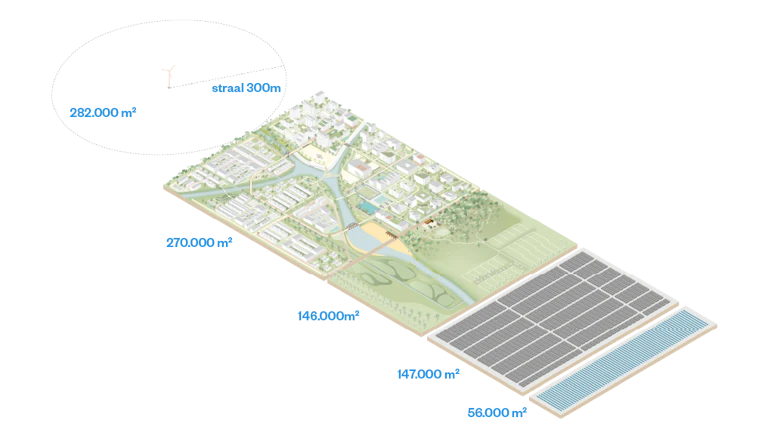
The process of making our energy system more sustainable is reaching its limits. The grid is full and space for expansion is limited. In addition, other transitions also require space. Together with energy specialist from DEP and architects and urban planners from Urban Synergy and Generation.Energy we worked together to develop a speculative alternative: The Balanswijk, a new neighborhood in an area with grid congestion, where all the necessary energy is generated, exchanged and stored locally. This goes beyond energy-neutral throughout the year: we aim to create balance at all times. Therefor, a clever integration of necessary infrastructures is required. An integral design of this neighborhood can achieve a sustainable, livable, healthy living environment for its inhabitants.


A new housing district that is balanced integrates passive energy solutions, takes the heat transition seriously, and utilizes local heat sources at a collective level.
Balanswijk 1.0 en 2.0
In our first design, Balanswijk 1.0, we show how this spatial puzzle can come together in a liveable neighbourhood. The challenge still lies in seasonal storage of heat for times when there is a high demand for energy or heat, but few possibilities for energy generation. This seasonal storage has been translated into numbers of batteries for the Balanswijk. No less than half a shipping container per home.
In response to this challenge, we developed three alternative scenarios for a speculative neighborhood of 25,000 homes operating independently from the electricity grid: variations of the Balanswijk featuring a district heating network (1), individual solutions based on ground loops and single-well systems (2), and a system combining aquifer thermal energy storage (ATES) with aquathermal energy (3).
District heat network
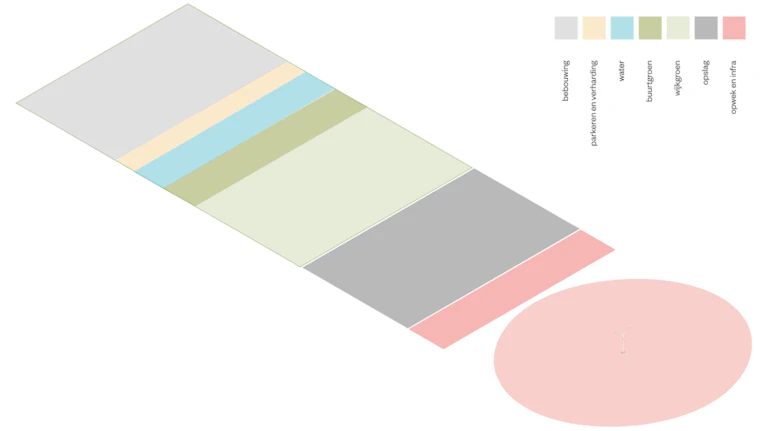
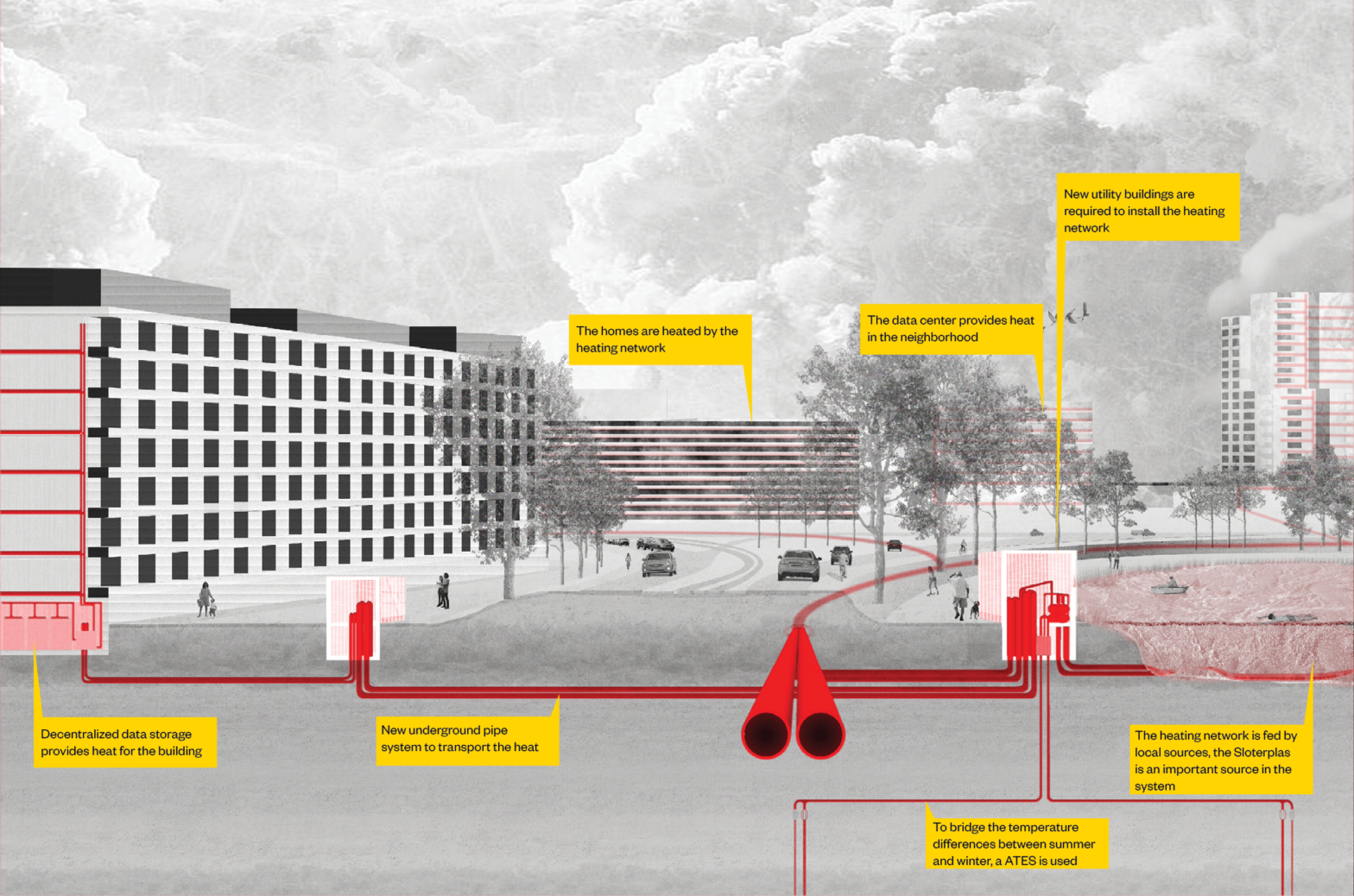
Balanswijk 2.0 with a district heating network is designed as a compact urban structure, ensuring that the underground heat network remains compact as well and minimizes heat losses. The heat source for the network depends on the local context and may consist of geothermal energy, industrial waste heat, or other locally available sources.
To bridge the winter period, calculations show that if biogas were used, approximately 583 cows, and therefore 2 332 000 m² of grassland, would be required (equivalent to roughly twice the area of the Balanswijk itself). Storing thermal energy in the form of hot water, whether above ground in hot-water storage tanks or underground in an aquifer, requires considerably less space.
With these improvements, the Balanswijk requires only about 40 batteries.
Aquathermal Energy
In the Balanswijk with aquathermal energy, water plays a central role, energetically and spatially. The required water surface area for regeneration of the underground heat storage is 2,233 m², based on a standing water body with a depth of 3 meters. Thanks to building-level heating solutions and a reasonably compact neighborhood layout, amenities are close by, and there is ample space for greenery, water retention, and social interaction. In this Balanswijk 53 batteries are needed to store electricity.
Individual solutions
In this Balanswijk we looked for individual solutions. The roofs feature both PV and PVT panels. A heat pump, water heater, and buffer tank supply the homes with hot water and low-temperature space heating. Ground loops (for terraced houses) and mono-wells (for apartments) allow the subsoil to store heat and cold. A home battery handles short-term storage, the space needed in every home is about 0,4 m³, which equals 46 batteries (containers) in total. The neighborhood features wide streets and a south-facing orientation. This ensures optimal solar yield and prevents buildings from casting shadows on neighbors.
The Balanswijk is not only a technical challenge; it is also a design opportunity to make the city smarter, more livable, and more sustainable.
Calculating and Designing
By translating the spatial and energy challenges into square meters, it became possible to develop urban designs that were aligned with the energy system. Calculation and design went hand in hand, each informing the other. In every scenario, multiple spatial challenges were combined: solar energy generated on rooftops, a wind turbine integrated into a green recreational landscape, batteries incorporated into mobility hubs or stacked to form an observation tower. Next to this behavior plays a big role in the Balanswijk. The design of the neighborhood creates possibilities for a different relation with energy. Each version of the Balanswijk fosters a different way of living: a passive house requires different habits and awareness than a home connected to a district heating network. Information and participation are therefore essential. For every Balanswijk a central meeting place is designed, where residents can learn about, discuss, and engage with the local energy system—the House of Energy.
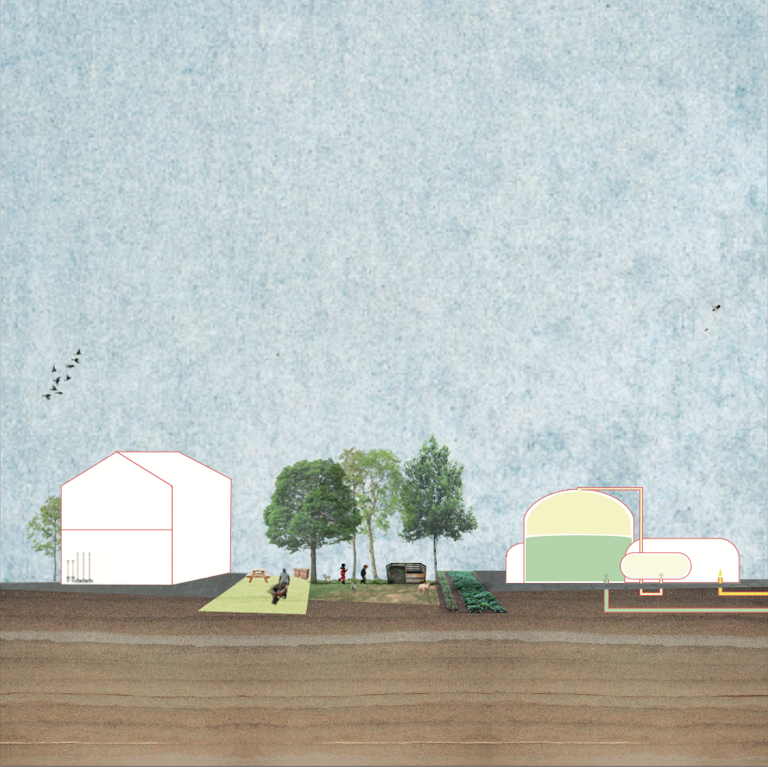
A neighborhood using biogas as energy source, the House of Energy is a space where waste becomes a shared resource. Organic material from kitchens, sewers, public spaces is collected here and transformed into renewable energy. It is a green meeting place for residents. People gather to borrow tools, manage street greenery, and pet the animals in the petting zoo. This biohub creates a space for initiatives like urban farming and a shared kitchen. This House of Energy creates a local, circular system that supports both the environment and the community.
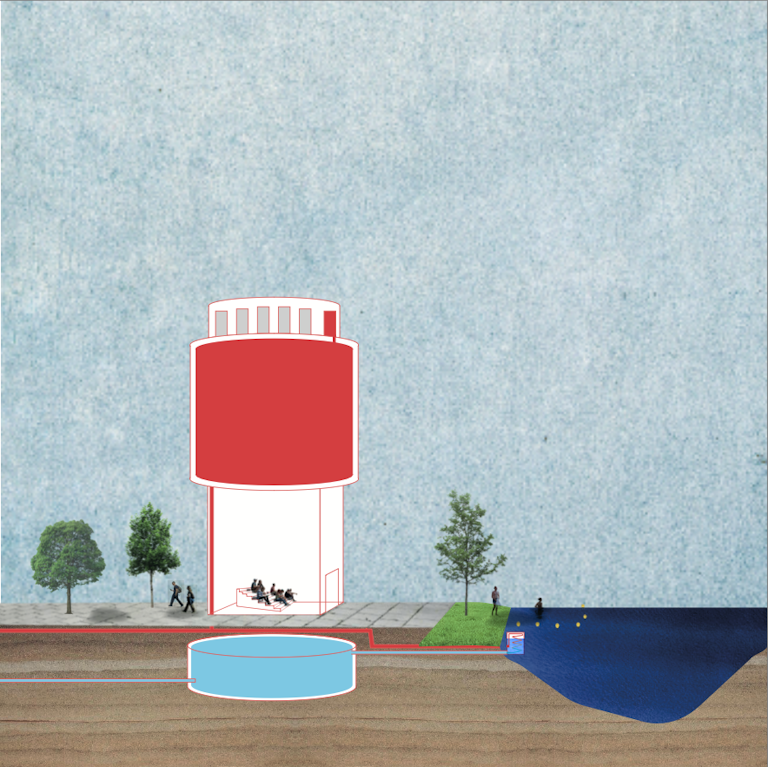
What if the neighborhood is heated by a hot water tank? In this House of Energy hot water storage is a shared facility. By cleverly designing this space, it also creates a welcoming meeting place where the neighborhood can discuss energy. This space makes energy storage visible and thus contributes to raising awareness about energy consumption and the social aspects of energy in the neighborhood.
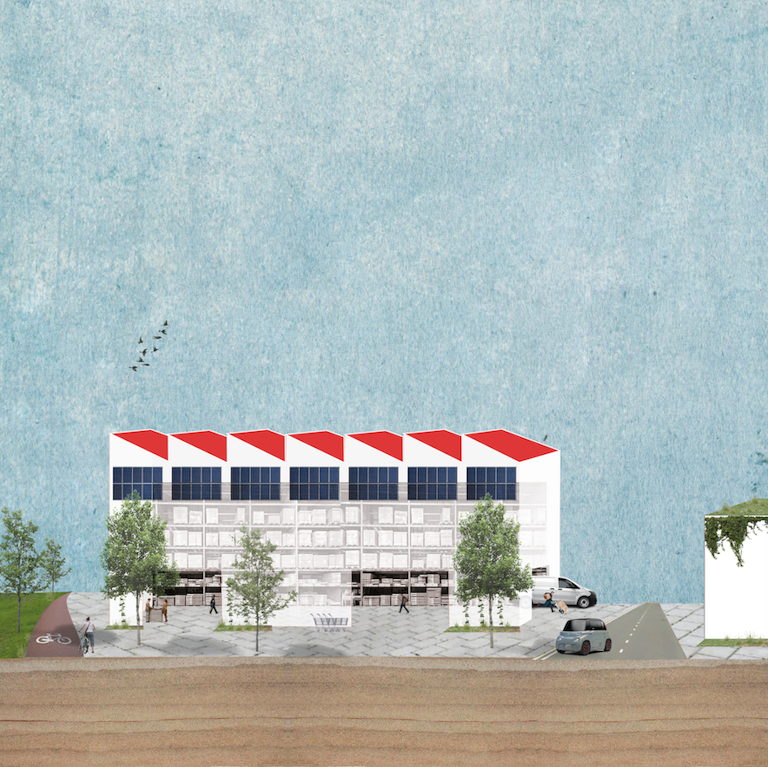
In a neighborhood with passive houses, where heating is organized privately, the House of Energy is located in the heart of the neighborhood. It serves as a hub where residents can access information from the service desk about how to live efficiently and comfortably in their passive homes. It also faces a solar square, making it a sunny meeting place. The House of Energy is easily accessible for pedestrians, cyclists, and motorists. Vans regularly deliver spare parts for individual home heating systems to ensure optimal maintenance.
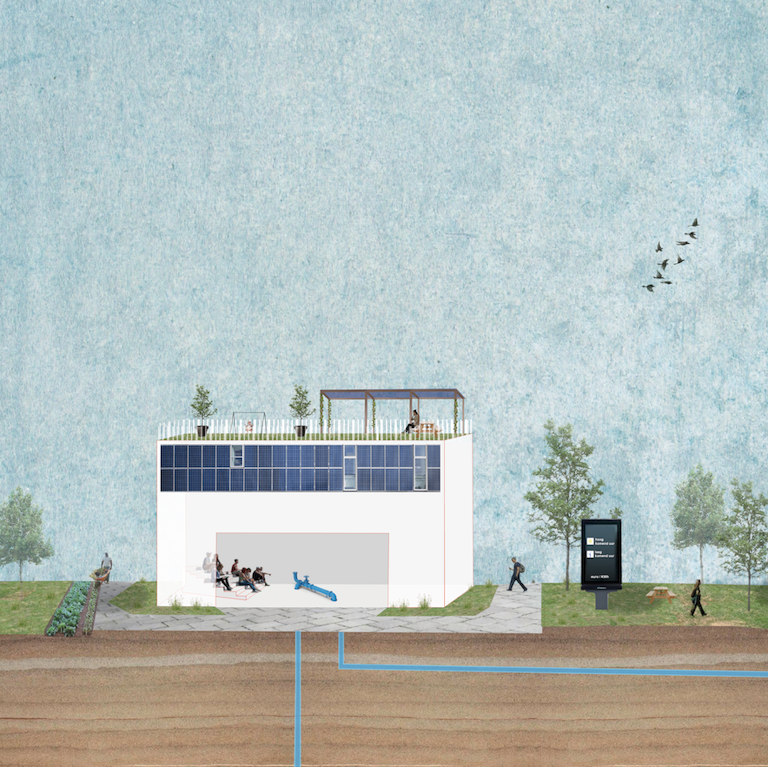
In a neighborhood that uses a source network to bring the heat (and cold) to the homes and other buildings the House of Energy is a place where this system is accessible for the neighborhood. This House of Energy is a wellhead for the thermal energy storage system. Here, the energy system is clearly visible in the neighborhood and also serves as a meeting place and information center. Locals exchange information here about the best ways to live in a passive house, as well as about managing the collective heat pumps. It also houses one of the four wellheads, which are accessible to the public.
Houses of Energy
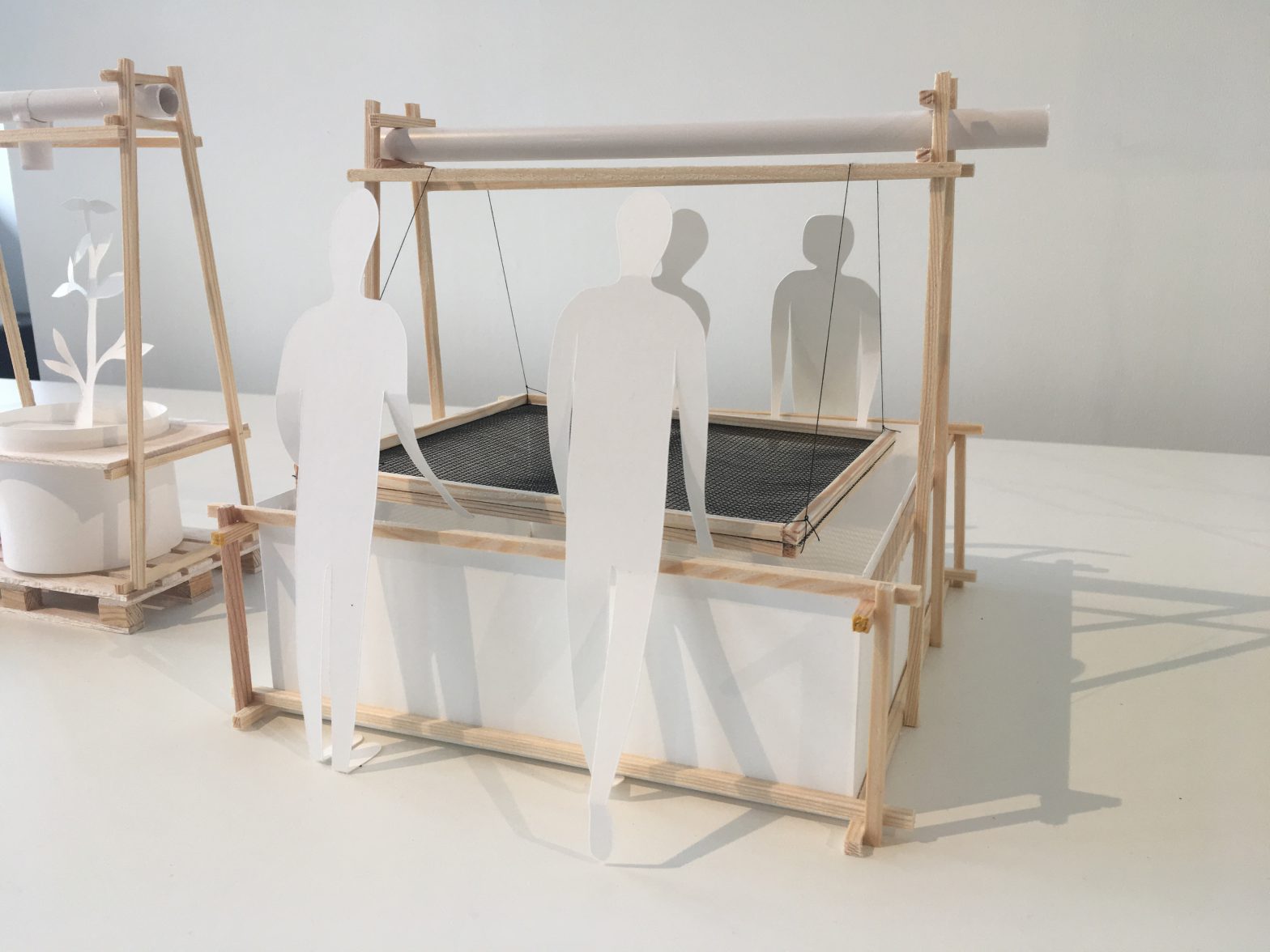
One intervention that plays a role in every Balanswijk is the House of Energy: a central gathering place with a social function, where residents can exchange information about energy, while also giving energy a visible and tangible presence within the neighborhood. These Houses of Energy bring together energy-infrastructure and social functions, integrating both into the spatial fabric of the district. Rather than concealing energy systems underground or behind technical facilities, they give energy a physical presence and create opportunities for community engagement.
More information:
https://www.liander.nl/voor-projectontwikkelaars/balanswijk#uitdaging
https://stadszaken.nl/artikel/6436/waar-komt-de-eerste-balanswijk-van-nederland
https://www.nu.nl/klimaat/6322037/de-woonwijk-van-de-toekomst-heeft-het-overvolle-stroomnet-helemaal-niet-nodig
 The Identity of Electricity
 Power to the People
 Shifting gears
 Energetic Eerbeek
 Stroom Westerschelde