Tear in the timeline
BEYOND 2050
The year 2050 is often an arbitrary finish line when defining visions and future perspectives. The further the extrapolation, the more uncertainties seem to arise. But time does not stop at 2050. A number of critical turning points actually lie beyond 2050. How do we make a future imaginable that lies beyond the horizon of 2050?
RHYTHMS AND RANDBIDGES
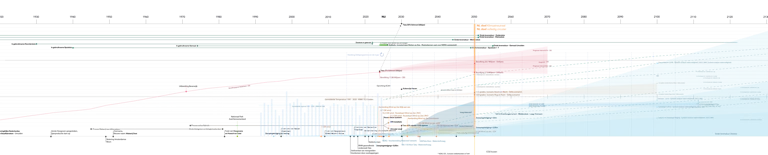
The timeline above is a visualization of various developments over time that may influence the future of the North Sea Canal area. Up to 2050, there are established policy objectives and sustainability deadlines, but also rhythms of the six-yearly update of the Delta Programme, the thirty-year concessions for offshore wind farms, and the hundred-year payback period of the recently completed IJmuiden Sea Lock.
After 2050, bandwidths related to climate change will be particularly dominant: the bandwidths of temperature and sea level rise, supplemented by the bandwidth of population size (both local and international).
TIME DILATATION
A dissonance arises between the agreement and implementation of a decision. The elaboration proceeds at a slower pace than the related developments
in our living environment, causing the outcome almost always to lag behind the requirements of the new situation. The bandwidth of the solution is often narrower than the bandwidth of the task. To anticipate future uncertainties,
it is therefore necessary to work with time dilation, a flexible space in time that can absorb any shocks over time.